Step Voltage: Definition, Calculation and Safe Limits
On this page
Step voltage is the voltage between two points on the surface of the ground one metre apart. The metre is not arbitrary: it is taken as the length of a person’s stride. If current is flowing into the soil nearby, the ground surface is no longer at a single potential, and someone standing with their feet apart bridges part of that difference with their own body, the current entering through one foot and leaving through the other.
The definition in IEC 60050-195 reads: the voltage between two points on the earth’s surface that are 1 m distant from each other, which is considered to be the stride length of a person.
Where it comes from
Soil is a poor conductor. When current enters the ground through an earth electrode, a buried cable fault or a conductor lying on the ground, it spreads outwards through a volume of soil that grows larger with distance. Close to the entry point the current density is high and so is the voltage drop per metre. Further out the same current is spread over a much larger area and the gradient flattens.
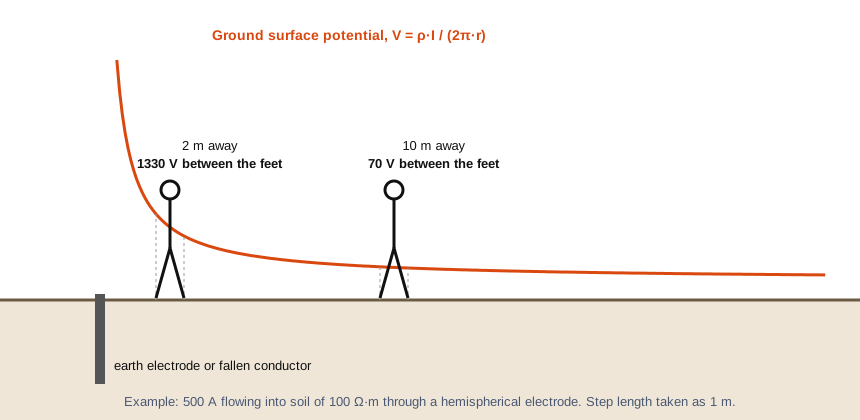
For the simplest case, a hemispherical electrode at the surface in uniform soil, the potential at distance r from its centre is:
V(r) = ρ × I / (2π × r)
where ρ is the soil resistivity in Ω·m and I is the current flowing into the ground. The step voltage at distance r is the difference between V at r and V at r + 1 m:
Ustep = (ρ × I / 2π) × (1/r − 1/(r + 1))
Real electrodes are rods, rings and meshes rather than hemispheres, and real soil comes in layers, so substation designers use more detailed models. The hemisphere still shows the shape of the problem correctly.
A worked example
An earth fault on the high-voltage side sends 500 A into the ground through a substation electrode. The soil is ordinary clay at 100 Ω·m.
- Standing 2 m from the electrode: Ustep = (100 × 500 / 6.283) × (1/2 − 1/3) = 7958 × 0.1667 ≈ 1330 V.
- Standing 10 m away: 7958 × (1/10 − 1/11) = 7958 × 0.0091 ≈ 72 V.
Moving eight metres further away cut the step voltage by a factor of almost twenty. That is the single most useful thing to remember about step voltage, and it is behind the advice about keeping well clear of fallen lines.
Where it matters in practice
- Substations and transformer stations, where the earth fault current on the high-voltage side can reach thousands of amperes. The earthing system is designed so that step and touch voltages inside the fence and just outside it stay within tolerable limits.
- Overhead line structures: towers and poles carrying a fault current to earth through their footings.
- A broken conductor lying on the ground. If the line has not tripped, which can happen on high-resistance ground such as dry sand or tarmac, the ground around the contact point is live in rings.
- Lightning strikes, where the current is enormous for microseconds. Many livestock deaths after storms are step voltage casualties: a cow’s front and hind hooves are well over a metre apart, so the animal spans more of the gradient than a person does, with the heart between the two current paths.
- Earth electrodes of low-voltage installations. Here the currents are small, a few amperes to a few tens of amperes, and the step voltage near a TT electrode is normally modest. It is still a reason to keep rod electrodes away from places where animals stand in wet ground.
Step voltage and touch voltage
Touch voltage is the voltage between a conductive part a person is touching and the ground under their feet, so the current path runs hand to feet and passes across the chest. Step voltage drives current from foot to foot through the legs and lower body, away from the heart. For the same voltage, a step exposure is therefore less dangerous than a touch exposure, and the tolerable step voltage is higher. That does not make step voltage harmless. A large step voltage can make the leg muscles contract, the person falls, and once they are lying on the ground the body spans a far larger voltage, now with the heart in the path.
Tolerable limits in substation design
The method most widely used, IEEE 80, gives the tolerable step and touch voltages for a body weight of 50 kg as:
Estep = (1000 + 6 × Cs × ρs) × 0.116 / √ts
Etouch = (1000 + 1.5 × Cs × ρs) × 0.116 / √ts
Here ρs is the resistivity of the surface layer, Cs is a derating factor for a thin surface layer (1 when there is none) and ts is the fault duration in seconds. The 1000 Ω is the assumed body resistance, and the term with ρs represents the resistance of the ground under the feet.
The formula shows why substations are covered in crushed stone. With a fault cleared in 0.5 s:
- on bare soil of 100 Ω·m: Estep = (1000 + 600) × 0.164 ≈ 260 V;
- on a 100 mm layer of crushed rock of 3000 Ω·m, with Cs around 0.7: Estep = (1000 + 12 600) × 0.164 ≈ 2230 V.
The rock layer raises the tolerable step voltage almost ninefold without changing anything underground. European practice under EN 50522 works with permissible touch voltages and treats step voltage as covered when touch voltage is under control, but the physics is the same.
How designers keep it down
- Bigger, meshed earth grids spread the current over a larger area and flatten the surface gradient.
- Grading rings, buried conductors at increasing depth around the perimeter, so the potential falls gradually at the edge instead of dropping off a cliff.
- High-resistivity surface layers: crushed stone or asphalt.
- Faster protection, because the tolerable voltage rises as the fault time falls.
- Keeping the fault current to earth low, for example by impedance earthing of the neutral on medium-voltage networks.
If you come across a fallen line
Treat it as live and stay at least 10 metres away, further on wet ground. If you are already close when you notice it, do not stride away. Keep your feet together and shuffle, never letting one foot leave the ground ahead of the other, or hop with both feet together, until you are well clear. Never touch a person who is in contact with the line or the ground next to it. Call the network operator and wait for them to confirm it is dead.
Related: earth electrode, electrical earthing, equipotential bonding.
References
- IEC 60050-195, International Electrotechnical Vocabulary: earthing and protection against electric shock.
- IEEE Std 80, Guide for Safety in AC Substation Grounding.
- EN 50522, Earthing of power installations exceeding 1 kV a.c.